⚛️ UC Santa Cruz • Hybrid Systems Lab

Jan de Priester

Ph.D. Candidate & Safe RL Researcher | UC Santa Cruz

I am a Ph.D. candidate in Electrical and Computer Engineering at the UC Santa Cruz Hybrid Systems Laboratory (expected Sept. 2027), advised by Prof. Ricardo G. Sanfelice. With 5+ years of experience in reinforcement learning and hybrid control, I develop learning-based control methods with formal safety, stability, and robustness guarantees.

My work focuses on building RL policies (Python, PyTorch, JAX) that prevent failure in adversarial edge cases—such as indecision and chattering around obstacles—and transfer reliably to physical hardware, as well as proving mathematically when standard RL policies intrinsically guarantee closed-loop stability. I am a first-author researcher (RLC 3×, ACC) and serve as a Senior Reviewer for RLC.

🎯 Seeking a 2027 Research Scientist role or internship in the SF Bay Area.
Jan de Priester
Ph.D. Candidate (2027)
UC Santa Cruz • ECE
Santa Cruz, CA
Research Overview

High-Level Research Directions

My research combines reinforcement learning with control and hybrid systems theory so that learned policies remain stable, decisive, and robust in the real world. Explore the three core directions below through visual animations and interactive articles.

Direction I • Hysteresis-Based RL & Hybrid Supervision HyRL • MultiHyRL • L-MultiHyRL • Timer Supervision

Hysteresis-Based Reinforcement Learning for Robust, Chatter-Free Autonomy

1. The Problem: Indecision & Chattering in Standard RL

When an autonomous agent navigates around obstacles or chooses between competing tasks, it must commit to a viable route. Because standard RL policies are continuous or memoryless discrete mappings, obstacles create decision boundaries where opposing paths diverge. Near these boundaries, small sensor noise or adversarial perturbations can make an alternative route appear momentarily better—causing the agent to rapidly switch back and forth (chattering), stall, or crash.

⚡ Why Standard & Recurrent RL Fall Short

Recurrent policies (RNNs) and frame stacking embed memory via continuous hidden states—which merely shifts the decision boundary into a higher-dimensional space rather than eliminating it. Under adversarial observation perturbations, standard RL obstacle-avoidance success drops to ~60% in 3D and below 25% in 2D.

🛠️ Our Approach (Visualized Below)

We combine RL policies with hybrid discrete memory to guarantee decisive commitment—using overlapping spatial hysteresis partitions (HyRL, MultiHyRL & L-MultiHyRL, with L-MultiHyRL predicting partition membership directly from onboard perception via learned latent features) or predictive dwell-time timers (Timer-Based Hybrid Supervisor) when switching boundaries between policies are complex or unknown in advance.

1. Baseline Failure: Chattering & Crash ● Standard Continuous RL
Why Memoryless RL Policies Fail Around Obstacles: As the vehicle steers toward the upper route (Phase 1), an adversarial perturbation shifts the obstacle upward to block its path. Blocked above, the memoryless policy switches to the lower route (Phase 2), where a downward shift blocks it again—triggering repeated route reversals (Phase 3) and a head-on collision.
2. Solution I: Spatial Hysteresis Partitions ● HyRL • MultiHyRL • L-MultiHyRL
Hysteresis-Based RL (Onboard Perception): Upper (blue) and Lower (green) partitions overlap around the centerline so both bypass routes are valid (Phase 1). When the obstacle shifts upward (Phase 2) or downward (Phase 3) to make the opposing route shorter, the agent stays inside its active partition, ignores the shortcut, and commits with 0 route reversals.
3. Solution II: Predictive Dwell-Time Timer ● Timer Supervisor (RLC '25)
Timer-Based Hybrid Supervisor (Complex Value Boundaries): When switching boundaries between multiple policies are fragmented or unknown in advance, our supervisor uses a short forward prediction (Phase 1) to forecast when an alternative policy becomes significantly better ($V_1$ exceeding $V_2$), locking in an adaptive dwell timer ($\delta_d = 5$) to safely clear each obstacle.
💡 Why It Matters & Where It Extends

Critical regions of indecision are not unique to obstacle avoidance—they arise whenever a continuous or discrete policy must choose between equally viable options. Left unaddressed, these boundaries are easily exploited by small perturbations or an adversary to trigger deadlocks or crashes. Crucially, scaling up to larger AI models does not remove this vulnerability: in higher-dimensional state spaces, critical decision boundaries persist in far more places than expected. Our methods provide a foundational layer of robustness against these structural failure modes across robotics and sequential decision-making for safety-critical applications.

Agile 3D Quadrotor / UAV Flight Vision-Based Obstacle Avoidance Adversarial-Resilient AI & Control Multi-Policy Decision-Making
📖 Deep-Dive Articles & Related Work

By embedding discrete hysteresis memory and predictive dwell timers, our methods achieve 100% obstacle avoidance success in simulation (vs. 60% for standard RL) and transfer reliably to physical hardware while preserving underlying policy performance and stability. Explore the full details in our interactive articles:

Direction II • Theoretical Foundations of RL Closed-Loop Practical Stability • Continuous Control

Intrinsic Practical Stability in Reinforcement Learning
1. The Setting & Core Question

Many continuous control tasks in robotics—such as legged locomotion, drone racing, and manipulation—are set-stabilization problems: the policy must steer the system toward and keep it within a desired target set or trajectory. Existing safe RL methods often constrain the learning algorithm with Lyapunov conditions or external safety filters, which can restrict exploration and complicate training.

2. Main Theoretical Result (RLC 2026)

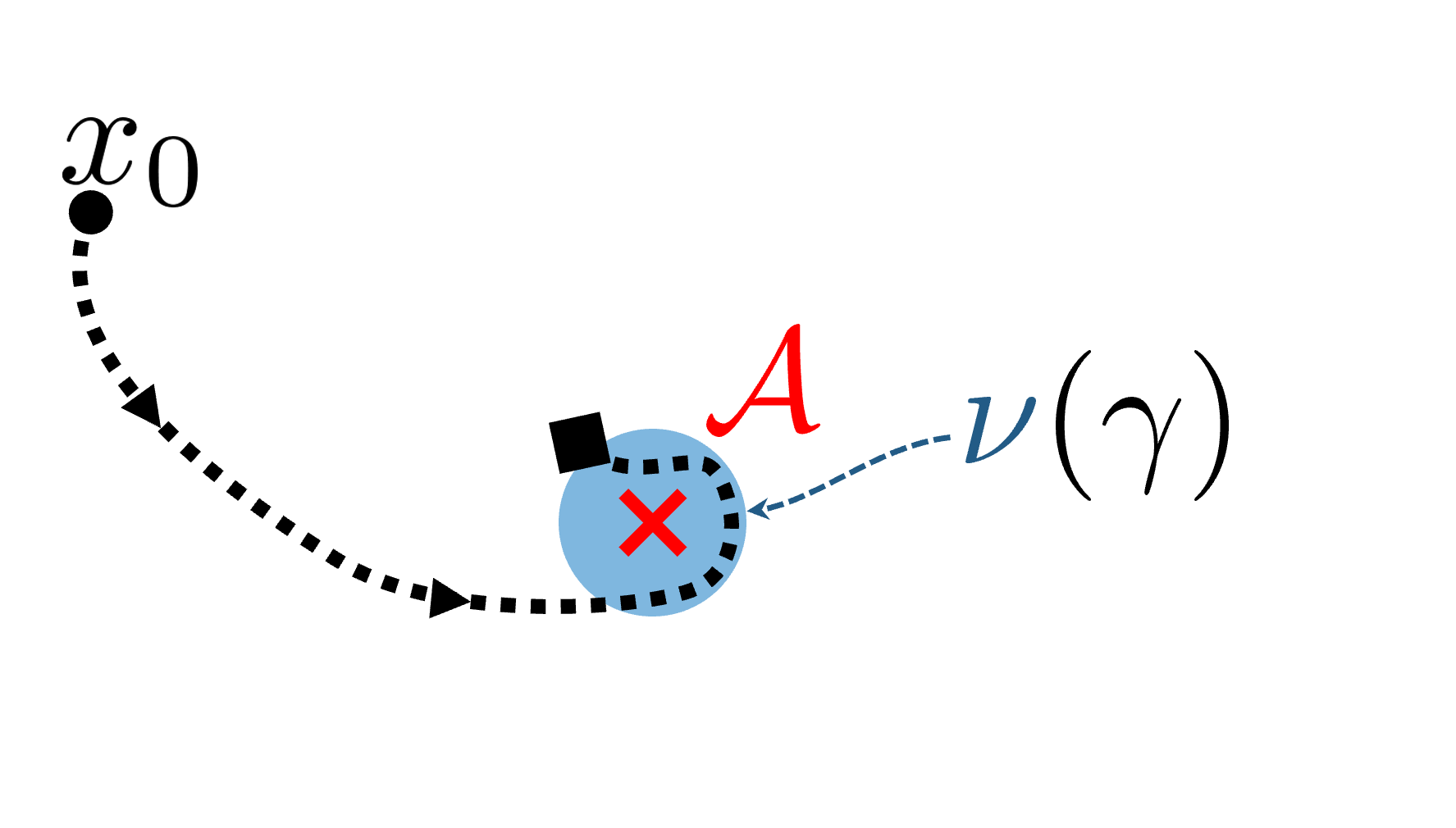
We prove mathematically that, for deterministic continuous control tasks with a continuous optimal policy, standard discounted RL policies intrinsically guarantee closed-loop practical asymptotic stability without imposing constraints on the learning process. Modeling the discount factor ($\gamma < 1$) and neural network approximation error ($\delta > 0$) as bounded disturbances shows that stability scales directly with learning performance: trajectories converge into a bounded neighborhood around the target that shrinks to zero as approximation error $\delta \to 0$ and, subsequently, $\gamma \to 1$.

1. Animation: Stabilizing a Locomotion Limit Cycle ● RLC 2026
Practical Stability of a Periodic Locomotion Gait: A galloping quadruped tracks a repeating target gait (dashed loops). Phase 1: As training progresses, neural network approximation error shrinks and the guaranteed stability tube tightens. Phase 2: As the discount factor approaches $1$ (farsighted), the tube contracts to the exact target gait.
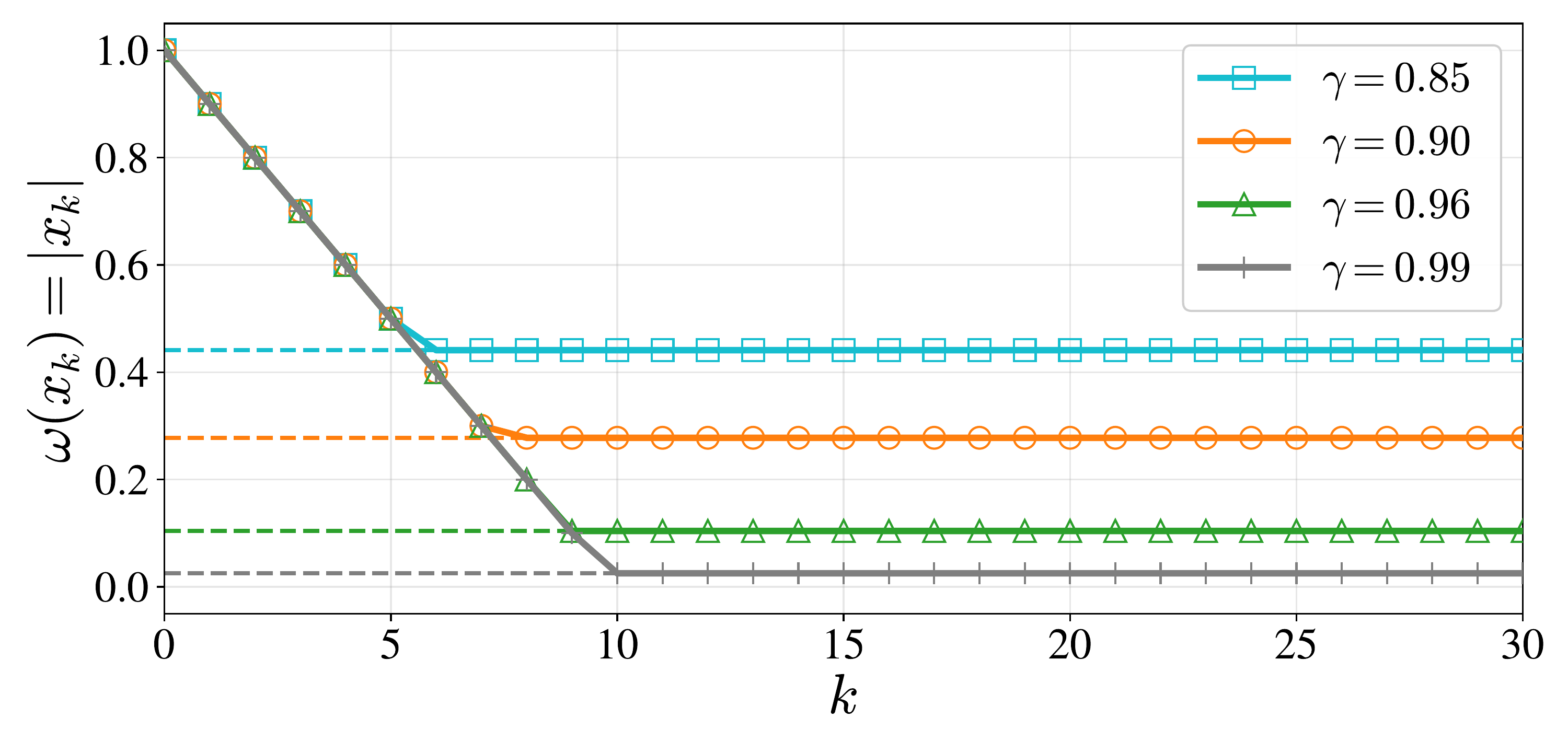
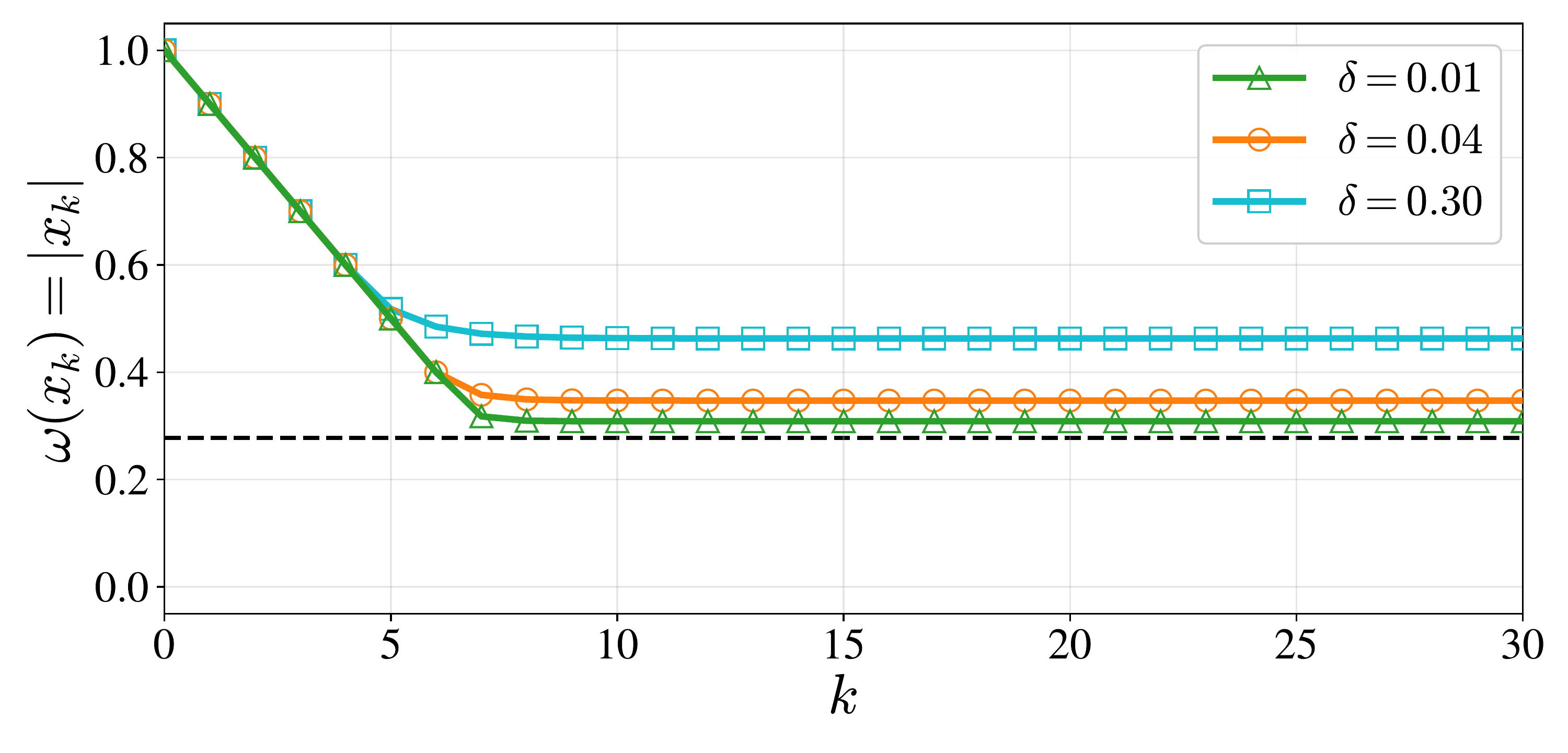
2. Theoretical Tubes & Steady-State Bounds ($\gamma, \delta$) ● Theorems 3.9 & 4.5
Theorem 3.9: Practical Stability Neighborhood under Discounting Numerical Steady-State Bounds Across Discount Factors
Theorem 4.5: Practical Stability Neighborhood under Neural Network Approximation Numerical Steady-State Bounds Across Approximation Errors
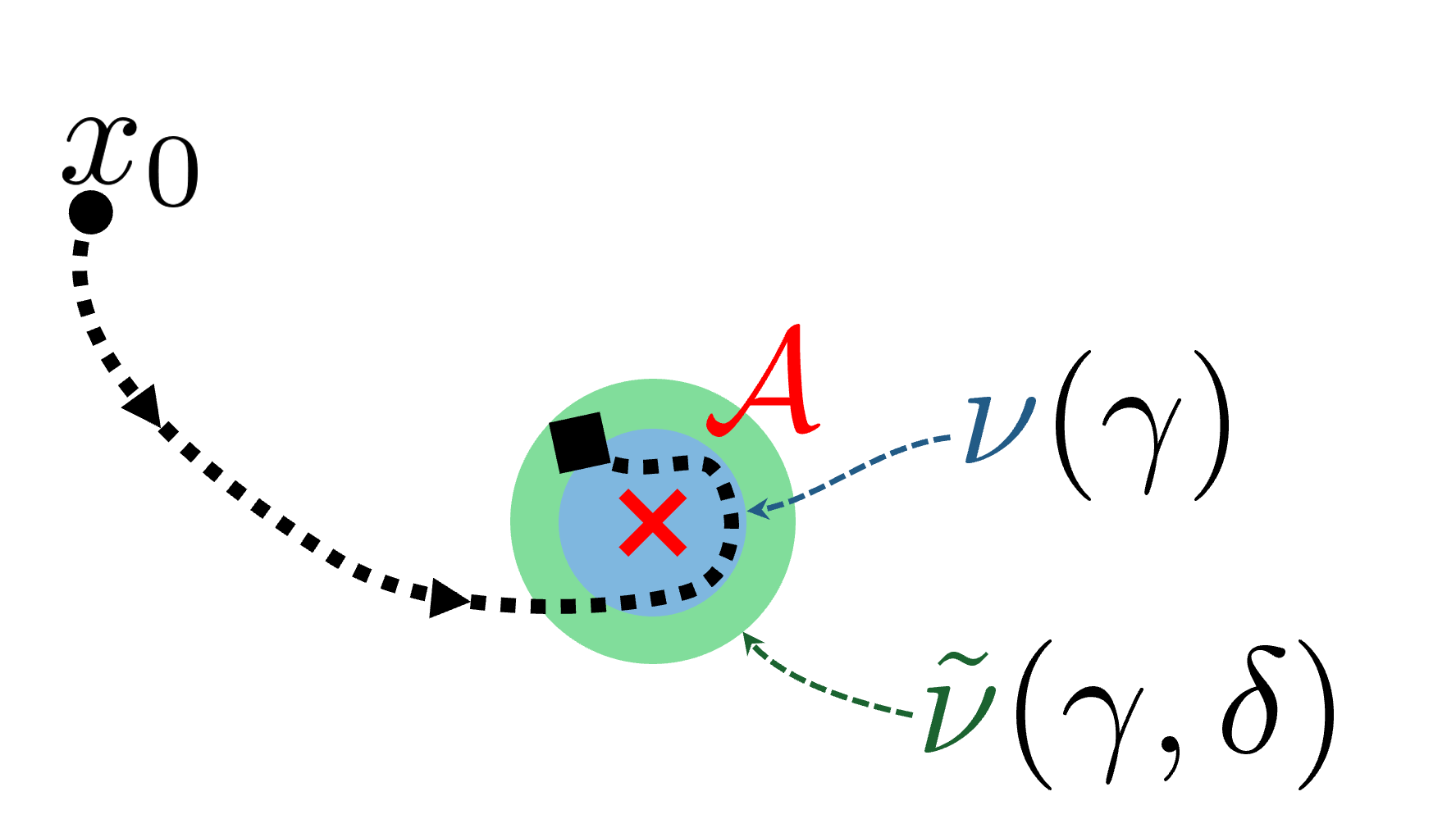
Analytical & Numerical Practical Stability Bounds: Top (Discounting $\gamma$): Trajectories converge into a neighborhood $\nu(\gamma)$ (blue) around $\mathcal{A}$ that shrinks toward zero as $\gamma \to 1$. Bottom (Network Error $\delta$): Approximation error expands the bound to $\tilde{\nu}(\gamma, \delta)$ (green), which contracts back to $\nu(\gamma)$ as $\delta \to 0$.
3. Why It Matters & Where It Extends

While training-time constraints remain valuable for safe exploration, this result shows that modifying the RL objective is often unnecessary to guarantee the stability of the deployed policy. It also explains why small steady-state offsets are a natural effect of discounting rather than an algorithmic bug, and guarantees that any target accuracy can be certified at a standard discount factor $\gamma < 1$.

Legged Locomotion & Limit Cycles Autonomous Drone Racing Principled Discount Factor Tuning Continuous Set Stabilization
📖 Interactive Deep-Dive Article & Paper

Explore the proof intuition and an interactive steady-state simulator where you can vary $\gamma$, $\delta$, and reward weights live in your browser:

Direction III • Physical Robotics & Sim-to-Real Validation ModalAI Sentinel UAV • 6-DoF Elfin e03 Manipulator

From Theory & Simulation to Physical Robots: Real-World Robustness Validation
1. The Goal: Scaling Theoretical Guarantees to Real Hardware

While our core methods are grounded in control theory and simulation, a central goal of this direction is showing that the robustness we design transfers reliably to physical robots. Real hardware introduces unmodeled aerodynamics, actuator delays, sensor drift, and contact dynamics—conditions where standard switching boundaries cause severe oscillations.

2. 3D Quadrotor Flight & Attitude Control (L-MultiHyRL)

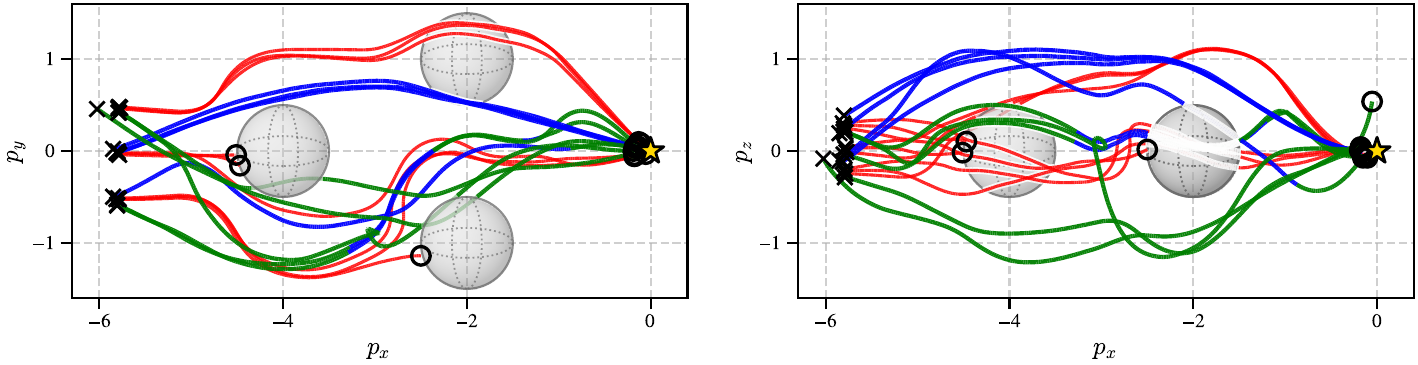
We deploy the simulation-derived closed-loop hybrid system from L-MultiHyRL—comprising the trained local policies, latent partition classifier, and discrete hysteresis logic—directly onboard a physical ModalAI Sentinel quadrotor (VOXL 2 at 25 Hz over ROS 2 / PX4) without retraining. Under adversarial obstacle shifts ($\varepsilon_p = 0.25\text{ m}$) and $\text{SO}(3)$ attitude disturbances ($\varepsilon_q = 0.4$) where standard PPO chatters and crashes, the hybrid system commits decisively to a single passage route and converges smoothly.

3. Robotic Contact & Force Regulation (IEEE CCTA 2026)

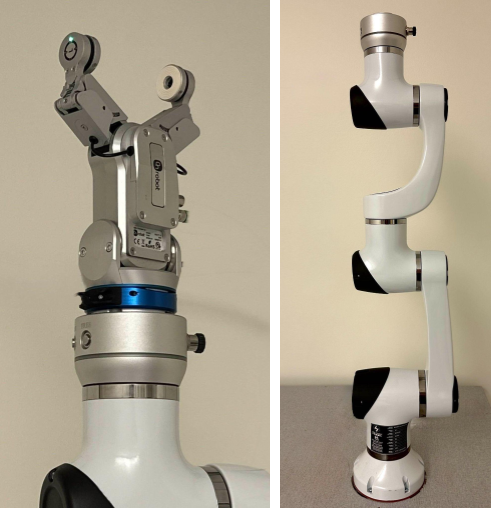
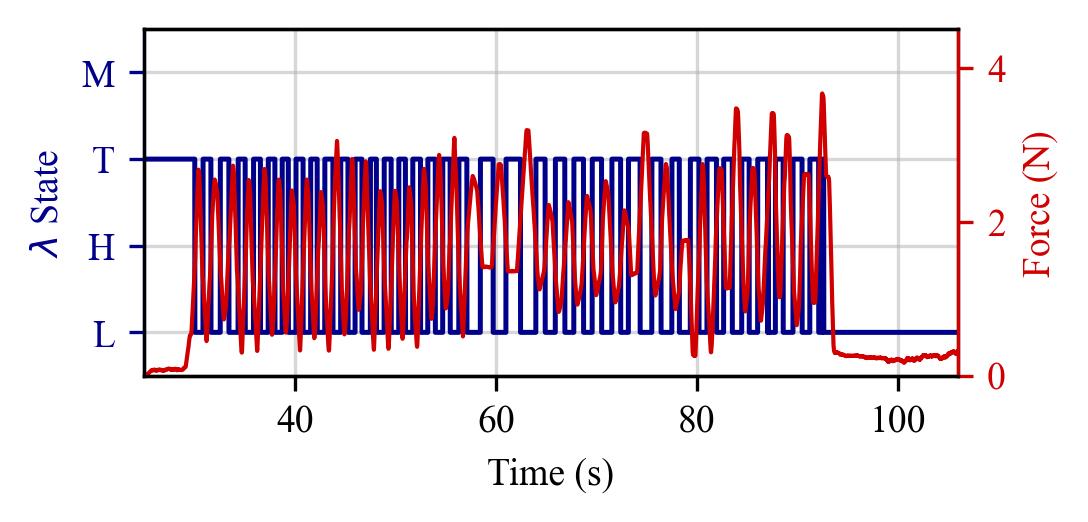
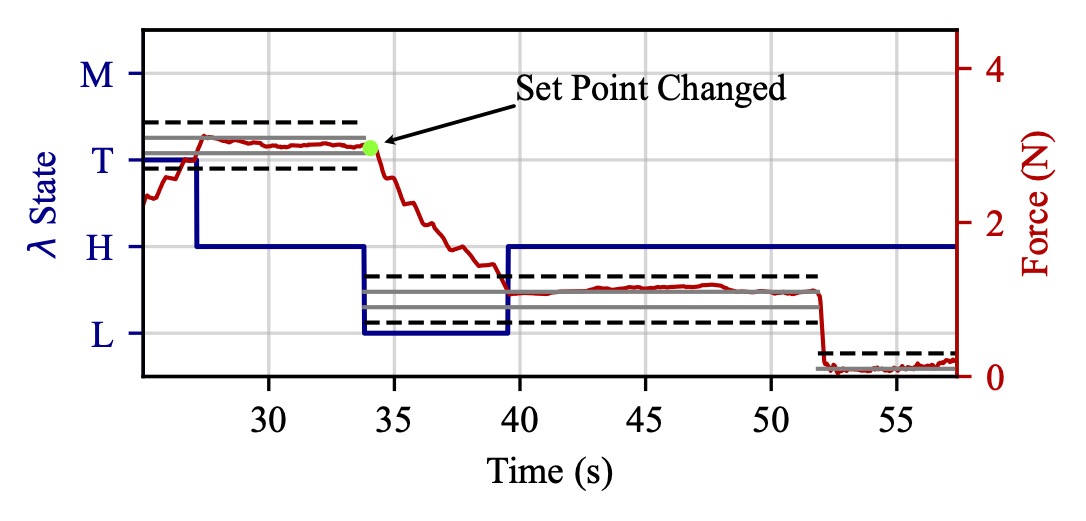
On a 6-DoF Elfin e03 manipulator with an OnRobot RG2FT force/torque gripper, we formulate a two-level hybrid hysteresis controller across free-space position control (`MOVE`) and quantized gripper force modes (`TIGHTEN`, `HOLD`, `LOOSEN`). Unlike baseline switching—which suffers from rapid force oscillations—our hysteresis logic maintains stable force regulation under setpoint changes, shifting centers of gravity, changing object stiffness, and 30-minute sensor drift.

1. 3D Quadrotor Flight & Attitude Tracking ● ModalAI Sentinel UAV
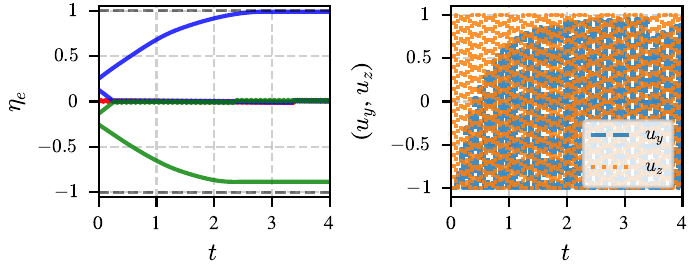
Physical ModalAI Sentinel Quadrotor Multi-Obstacle Flight Trajectories Hardware Attitude Chattering Under Standard PPO Hardware Chatter-Free Attitude Convergence Under L-MultiHyRL
Closed-Loop Hybrid Deployment on a ModalAI Sentinel Quadrotor: Top: Physical 3D multi-obstacle flights ($\varepsilon_p = 0.25\text{ m}$)—Standard PPO (red) chatters and collides, while the L-MultiHyRL closed-loop hybrid system (blue/green) flies collision-free. Middle vs. Bottom: Hardware $\text{SO}(3)$ attitude tracking ($\varepsilon_q = 0.4$) comparing Standard PPO control chattering (middle) against smooth L-MultiHyRL convergence (bottom).
2. 6-DoF Manipulator & Contact Force Regulation ● IEEE CCTA 2026
RG2FT End Effector and 6-DoF Elfin e03 Manipulator Hardware Setup
Baseline Force Chattering Without Hysteresis Chatter-Free Hysteresis Force Regulation
Hysteresis Contact & Force Control on a 6-DoF Manipulator: Left: Physical Elfin e03 6-DoF arm and RG2FT force/torque gripper. Right (Top): Baseline switching without hysteresis suffers from rapid state and contact-force oscillations. Right (Bottom): Our hysteresis controller smoothly regulates $3\text{ N}$ and $1\text{ N}$ contact force setpoints without chattering.
💡 Why It Matters & Where It Extends

Physical robots regularly operate across switching boundaries—both in 3D aerial obstacle avoidance and attitude tracking and in contact-rich manipulation between free-space motion and force control. Discrete hysteresis provides a lightweight, general mechanism that prevents hardware chattering and transfers reliably from simulation to the real world.

Onboard UAV Flight (PX4 / ROS 2) SO(3) Quaternion Attitude Control Sim-to-Real Hybrid Deployment 6-DoF Force & Contact Control
📖 Hardware Validation & Related Work

Explore the experimental flight results and physical manipulation studies in detail:

Accessible Deep Dives

Featured Research Articles

Read concise, visual explanations of our research—complete with intuitive diagrams, animations, and experimental results.

Updates

Recent News

Sep 15, 2026 Completed physical quadrotor hardware experiments for L-MultiHyRL: Latent Multi-Policy Hysteresis-Based RL for Robust 3D Obstacle Avoidance in $\text{SE}(3)$ and $\text{SO}(3)$ on a ModalAI Sentinel UAV! Read our interactive research article.
May 07, 2026 Our collaborative paper An Experimentally Validated Hybrid Control Strategy for Robust Contact Detection and Force Regulation has been accepted to CCTA 2026! This work demonstrates a hysteresis-based framework to eliminate end-effector chattering in physical 6-link manipulators.
May 05, 2026 Our paper Intrinsic Closed-Loop Practical Asymptotic Stability in Discrete-Time Reinforcement Learning has been accepted to RLC 2026! We prove that the unmodified discounted RL objective intrinsically guarantees practical asymptotic stability for continuous control tasks. Read the deep-dive article or PDF.
Dec 08, 2025 Officially advanced to Ph.D. Candidacy in the Department of Electrical and Computer Engineering at UC Santa Cruz!
May 09, 2025 A new paper titled A Timer-Based Hybrid Supervisor for Robust, Chatter-Free Policy Switching has been accepted to RLC 2025! This work introduces a hybrid supervisor to guarantee robust, chatter-free policy switching in RL.
May 14, 2024 A new paper titled MultiHyRL: Robust Hybrid RL for Obstacle Avoidance against Adversarial Attacks on the Observation Space has been accepted to RLC 2024! We present a novel hybrid RL algorithm featuring hysteresis-based switching for robust obstacle avoidance
Bibliography

Selected Publications

View all papers organized by research area on the full publications page →

  1. Preprint
    Latent Multi-Policy Hysteresis-Based Reinforcement Learning for Robust 3D Obstacle Avoidance
    Jan de Priester, Joseph Lullo, Kyle Volle, and 2 more authors
    2026
    In preparation, target IEEE Transactions on Robot Learning (T-RL)
  2. RLC
    Intrinsic Closed-Loop Practical Asymptotic Stability in Discrete-Time Reinforcement Learning
    Jan de Priester and Ricardo G. Sanfelice
    In Reinforcement Learning Conference (RLC) / Reinforcement Learning Journal (RLJ), 2026
  3. RLC
    A Timer-Based Hybrid Supervisor for Robust, Chatter-Free Policy Switching
    Jan de Priester and Ricardo G. Sanfelice
    In Reinforcement Learning Conference (RLC) / Reinforcement Learning Journal (RLJ), 2025
  4. RLC
    MultiHyRL: Robust Hybrid RL for Obstacle Avoidance against Adversarial Attacks on the Observation Space
    Jan de Priester, Zachary Bell, Prashant Ganesh, and 1 more author
    In Reinforcement Learning Conference (RLC) / Reinforcement Learning Journal (RLJ), 2024