Hysteresis-Based Reinforcement Learning for Chatter-Free Autonomy
Eliminating Structural Indecision and Adversarial Chattering in Safety-Critical Sequential Decision-Making (HyRL, MultiHyRL & L-MultiHyRL)
📄 Research Overview: HyRL (ACC 2022) • MultiHyRL (RLC 2024) • L-MultiHyRL (2026)
This article provides a unified overview of our line of research on Hysteresis-Based Reinforcement Learning—spanning our published foundational algorithms in HyRL (ACC 2022) (de Priester et al., 2022) and MultiHyRL (RLC 2024) (de Priester et al., 2024), and highlighting simulation and physical quadrotor flight results from our latest 3D extension, L-MultiHyRL (de Priester et al., 2026) (manuscript in preparation; full algorithmic details to appear upon publication): [ACC 2022 PDF →] [RLC 2024 PDF →]
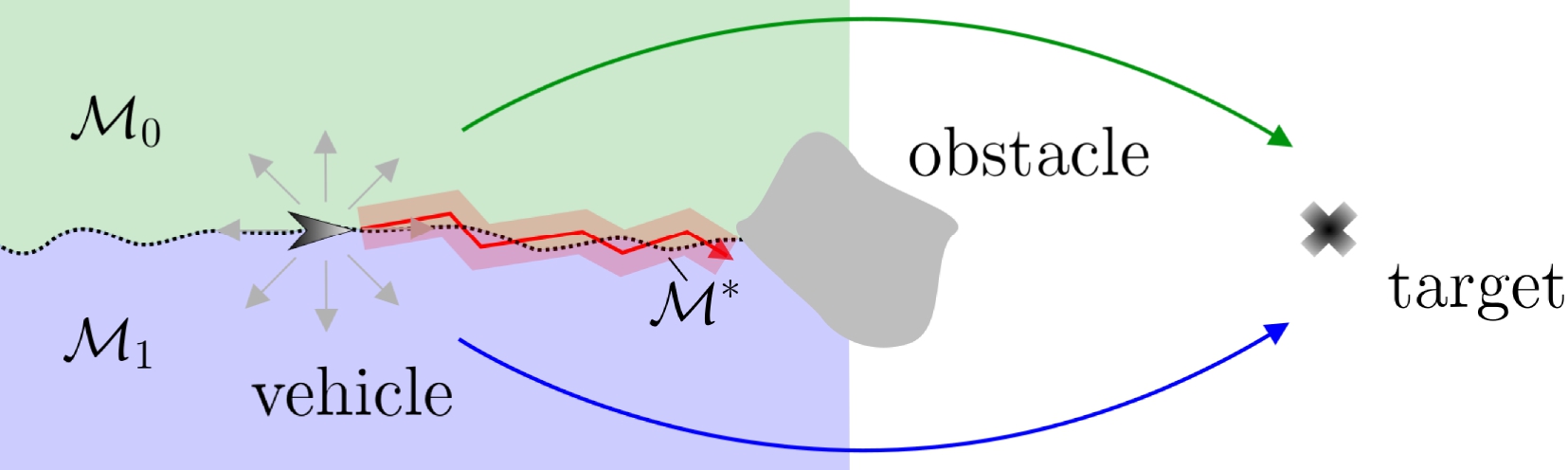
In sequential decision-making for safety-critical applications, an autonomous agent must frequently choose between multiple equally viable options—whether selecting a trajectory around an obstacle, choosing a rotation direction, or committing to one of several competing tasks. Because standard continuous and discrete reinforcement learning (RL) policies are memoryless mappings from observations to actions, these choices create critical regions of indecision ($\mathcal{M}^\ast$) in the state space where opposing decisions diverge.
Near these critical boundaries, small sensor noise or an adversary can easily perturb the agent’s observations to make an alternative option appear momentarily better—causing the policy to rapidly oscillate back and forth (chattering), stall in a deadlock, or crash. Crucially, scaling up to larger neural networks and more advanced AI models does not eliminate this vulnerability: in higher-dimensional state spaces, critical decision boundaries persist across the state space in far more places than expected.
Autonomous obstacle avoidance and attitude control provide a clear, visual setting where this structural failure mode appears directly. Whenever a vehicle approaches an obstacle on its way to a target, it must commit to a bypass route (passing above or below in 2D, or maneuvering in 3D space). Along the critical boundary $\mathcal{M}^\ast$ ahead of the obstacle, small adversarial observation shifts move the perceived obstacle into the vehicle’s active passage direction—making the opposing route appear shorter and causing a memoryless agent to chatter until it collides head-on.

Across HyRL (de Priester et al., 2022), MultiHyRL (de Priester et al., 2024), and L-MultiHyRL (de Priester et al., 2026), our core insight is simple:
Continuous neural networks cannot robustly break symmetry around obstacles without discrete memory. By partitioning the state space into overlapping regions and embedding specialized RL policies inside a closed-loop hybrid system with hysteresis switching, Hysteresis-Based Reinforcement Learning eliminates decision chattering and guarantees decisive, collision-free obstacle avoidance under worst-case observation noise.
1. How Hysteresis-Based RL Works: Overlapping Partitions & Hysteresis Logic
How do we systematically eliminate topological chattering without hand-crafting avoidance controllers? Beginning with our ACC 2022 (de Priester et al., 2022) and RLC 2024 (de Priester et al., 2024) papers, we established a general hysteresis-based reinforcement learning framework built on three steps:
- Empirical Critical Point Identification: Starting from a single baseline RL policy, we probe the environment with small opposing state perturbations $\pm \nu$. States from which perturbed rollouts split around opposite sides of an obstacle reveal the baseline policy’s vulnerable critical region $\mathcal{M}^\ast$ (panel a below).
- Overlapping State-Space Partitioning: We bisect the critical region $\mathcal{M}^\ast$ into two domains $\mathcal M_1$ (e.g., an Upper Partition) and $\mathcal M_2$ (e.g., a Lower Partition) and expand each across the centerline boundary by a margin $\rho$ to create an overlapping hysteresis region ($\mathcal M_1^{\text{exp}} \cap \mathcal M_2^{\text{exp}}$) whose width exceeds the worst-case sensor or adversarial perturbation (panels b and c below).
- Dedicated Policies & Hysteresis Switching Logic: Two specialized RL policies are trained on the overlapping domains—one committed to passing each side of the obstacle. A discrete logic state locks in the initialized policy inside the overlap and ignores perturbation-induced shortcuts, only permitting a switch if the vehicle moves completely outside the active policy’s expanded partition.

Scaling from Single-Obstacle State Feedback to Multi-Obstacle Visual Perception
- HyRL (ACC 2022) (de Priester et al., 2022) introduced this hysteresis-based RL architecture for single-obstacle avoidance using state coordinates (below left), proving that overlapping training sets prevent adversarial chattering along $\mathcal{M}^\ast$.
- MultiHyRL (RLC 2024) (de Priester et al., 2024) generalized the framework to cluttered multi-obstacle 2D arenas and local bird’s-eye-view visual observations (below right), combining a CNN-MLP perception architecture with directional hysteresis and obstacle-focus switching across relaxed Voronoi cells.


2. Extending to 3D Flight & Attitude Tracking: L-MultiHyRL Results (2026)
In our latest work on Latent Multi-Policy Hysteresis-Based Reinforcement Learning (L-MultiHyRL) (de Priester et al., 2026), we extend hysteresis-based reinforcement learning from 2D planar navigation to full 3D aerial flight in $\text{SE}(3)$ and rotational attitude tracking in $\text{SO}(3)$ using local onboard visual observations.
In 3D flight, a vehicle faces two simultaneous topological obstructions:
- 3D Spatial Obstacle Avoidance: Breaking symmetry around 3D obstacles in cluttered environments under position observation noise $\varepsilon_p$.
- 3D Attitude Tracking on $\text{SO}(3)$: Because antipodal unit quaternions $\pm q_e$ represent the same physical 3D orientation via opposite rotation directions, continuous policies encounter a critical switching boundary at a $180^\circ$ rotation error ($\eta_e = 0$), where attitude noise $\varepsilon_q$ induces violent angular velocity chattering.
(Because the L-MultiHyRL manuscript is currently under review, we omit the internal algorithmic and architectural details here and highlight the 3D simulation and physical hardware validation results below.)
3D Simulation Benchmark: Single- & Multi-Obstacle Navigation
Across 1,000 randomized 3D initial conditions under worst-case adversarial observation shifts ($\varepsilon_p = 0.20\text{ m}$) and attitude disturbances ($\varepsilon_q = 0.4$), Standard PPO suffers from severe chattering—colliding with obstacles in 3D space and stalling at unaligned orientations near $\eta_e = 0$. In contrast, L-MultiHyRL achieves 100.0% collision-free convergence across every tested noise level:


3. Physical Flight Validation on a ModalAI Sentinel Quadrotor
To verify that these robustness gains transfer to real-world aerial hardware under aerodynamic disturbances and closed-loop tracking delays, we deployed the simulation-derived closed-loop hybrid system—consisting of the trained local policies, latent partition classifier, and discrete hysteresis logic—directly onboard a physical ModalAI Sentinel quadrotor (VOXL 2 companion computer running at 25 Hz over ROS 2 / PX4) inside a motion-capture flight arena without retraining or hardware-specific fine-tuning.


🛠️ Broader Impact: A Foundation for Robustness in Modern AI & Robotics
Critical regions of indecision are not limited to obstacle avoidance—they arise whenever a continuous or discrete policy must choose between equally viable options. Left unaddressed, these boundaries can be easily exploited by small perturbations or an adversary to trigger deadlocks or crashes. Crucially, scaling up to larger neural networks and more advanced AI models does not eliminate this vulnerability: in higher-dimensional state spaces, critical decision boundaries persist in far more places than expected. From 2D state-based HyRL (ACC 2022) (de Priester et al., 2022) and 2D vision-based MultiHyRL (RLC 2024) (de Priester et al., 2024) to 3D L-MultiHyRL (2026) (de Priester et al., 2026), our methods provide a foundational layer of robustness against these structural failure modes across robotics and sequential decision-making for safety-critical applications.